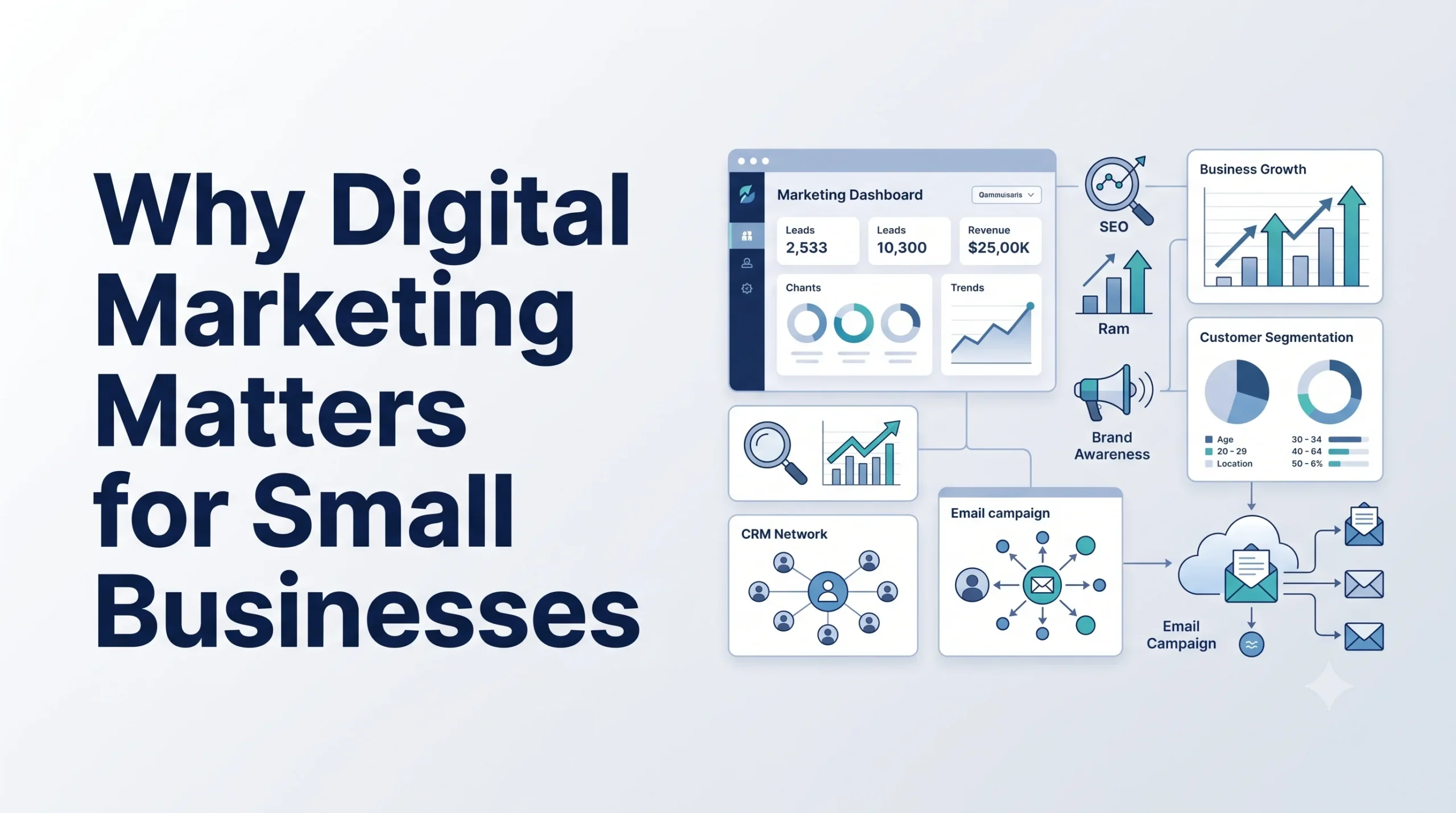
Why Digital Marketing Matters for Small Businesses
For a long time, small business marketing relied almost entirely on local visibility. If you owned a neighborhood bakery, a boutique clothing store, or a local consulting firm, your growth depended on foot traffic, print flyers, local newspaper ads, or word-of-mouth recommendations. While these traditional methods built tight-knit local roots, they forced small operations to face a harsh reality: competing with large corporations that held multi-million dollar advertising budgets was nearly impossible.
The internet completely changed that dynamic. Today, a small business operating out of a home office can access the exact same digital platforms, search engines, and target audiences as a global conglomerate.
Whether you are a local service provider trying to attract more clients, an e-commerce startup scaling your storefront, or a business owner evaluating software tools to streamline your workflows, online growth requires a solid digital strategy. This comprehensive guide details why digital marketing matters for small businesses, how it levels the playing field, and how you can implement it sustainably.
What is Digital Marketing?
Before examining its specific value for small businesses, we must establish a clear definition. Digital marketing includes any marketing activity that utilizes an electronic device or the internet to promote a brand, product, or service. Instead of relying on physical, static media, businesses communicate with their audiences through search engines, websites, social media platforms, mobile applications, and email.
At its core, digital marketing shifts communication from a passive, one-way broadcast into an interactive, data-driven conversation. When a consumer interacts with a digital ad, reads a blog post, or opens an email, they are not just viewing an advertisement; they can click, reply, purchase, or leave feedback instantly.
For a complete breakdown of the core mechanics governing this ecosystem, explore our foundational guide, What Is Digital Marketing?
Why Digital Marketing Is Important for Small Businesses
For a small business, digital marketing is not simply an alternative way to hand out business cards. It is an operational necessity that directly impacts your ability to survive and scale in a modern economy.
Overcoming Geographical Limits
Traditional advertising is naturally constrained by geography. A local billboard or storefront sign only reaches individuals who physically pass by that specific location. Digital strategies remove these borders completely. A niche local artisan can sell their goods to a customer thousands of miles away, opening up entirely new revenue streams that were structurally impossible a generation ago.
Competing with Large Brands
Large corporations routinely spend millions on prime-time television commercials or high-profile sponsorships. A small business cannot compete on pure financial volume. However, search engine algorithms and social media networks prioritize relevance, helpfulness, and user engagement over the size of a company’s bank account. If your small business provides an exceptional answer to a user’s search query, you can outrank a billion-dollar brand on the search results page.
Meeting Consumers Where They Live
Modern buying habits have fundamentally shifted. Consumers rarely walk into a store blindly; they research solutions on search engines, read independent software reviews, check social proof on forums, and read educational blog posts first. If your small business does not maintain an active online presence, you effectively opt out of the conversation before the buyer even makes their initial purchasing decision.
How Digital Marketing Works for Smaller Budgets
Digital marketing operates through an interconnected digital funnel. Rather than forcing you to spend massive amounts of money upfront, it allows you to build a step-by-step framework that captures interest and converts it into revenue over time.
The process typically moves through a highly repeatable customer acquisition cycle:
[Discovery]  --> A user finds your helpful blog post via organic Google search.
[Nurturing]  --> The user signs up for your newsletter to receive free, practical tips.
[Conversion] --> An automated email delivers a tailored offer, leading to a purchase.
To run this funnel efficiently without hiring a massive internal team, small businesses utilize specialized, cost-effective software platforms. These systems automate tracking, content delivery, and audience communications, allowing a small team to manage thousands of customer touchpoints simultaneously.
Core Types of Digital Marketing for Small Businesses
While the digital landscape contains many specialized strategies, small businesses generally see the highest return on investment by mastering a few core pillars. For a deeper look at all the available options, read our guide on The Different Types of Digital Marketing Explained .
1. Search Engine Optimization (SEO)
SEO is the process of optimizing your website content so that it ranks prominently in organic (unpaid) search engine results when users look for terms related to your business.
- Local SEO: This is the lifeblood of physical service providers and brick-and-mortar storefronts. By optimizing your business for localized searches (such as “plumber near me” or “best coffee shop in [City]”), you capture high-intent customers at the exact moment they need your services.
- On-Page SEO: Writing clear, highly educational blog posts that answer specific questions your target audience is asking online.
- Technical SEO: Structuring your website so that it loads quickly, displays beautifully on mobile devices, and is easy for search engine crawlers to navigate.
2. Email Marketing
Email marketing involves building a database of individuals who have explicitly opted in to receive communications from your brand. Because you do not have to pay a third-party platform to reach your subscribers, email delivers one of the highest returns on investment of any digital strategy. It is highly effective for sharing educational tips, launching promotions, and turning one-time buyers into repeat clients. To learn how to build your initial system, review our guide on Email Marketing Basics .
3. Content Marketing
Content marketing focuses on creating and sharing free, high-quality information—such as blog articles, guides, and videos—that solves your audience’s pain points. Instead of constantly pitching your products, you demonstrate your expertise. Over time, this educational approach builds authority, making readers far more likely to buy from you when they are ready to make a purchase.
4. Marketing Automation
Small business owners wear many hats, from accounting to customer service. Marketing automation software handles repetitive tasks for you. For example, when a user signs up for a free guide on your site, an automated workflow can send a welcome email instantly without you lifting a finger. To discover how this saves time, see Marketing Automation Explained .
5. Social Media Marketing
Maintaining an active presence on platforms like LinkedIn, Facebook, or Instagram helps small businesses build a community, handle customer queries, and showcase behind-the-scenes authenticity. Rather than trying to be on every platform, successful small businesses focus on the one or two networks where their ideal clients actually spend time.
The Benefits of Going Digital
Shifting your marketing efforts from traditional print or local ads to digital platforms offers unique advantages that align perfectly with small business constraints.
Unmatched Cost Control
Traditional campaigns require high upfront payments. Printing hundreds of physical brochures or buying a radio ad spot costs significant money before you see a single lead. Digital marketing allows you to start incredibly small. You can launch a targeted social media ad or an email campaign for a minimal cost, monitoring performance in real time and increasing your budget only when you see clear results.
Precise Tracking and Analytics
With print advertising, calculating your exact return on investment is incredibly difficult. You cannot know for certain how many customers walked through your door because of a specific newspaper clipping. Digital marketing eliminates this guesswork entirely. By using standard web tracking tools, you can trace a customer’s journey from their initial click on a search result to the exact email that convinced them to buy. To understand which metrics you should track, consult our Email Analytics Guide .
Granular Audience Targeting
Digital channels allow you to move past broad, inefficient demographic targeting. Instead of showing your message to every resident in a zip code, you can target your marketing exclusively to individuals who have visited your website’s pricing page, or who have demonstrated a specific intent to purchase your type of solution.
Challenges Small Businesses Face in Digital Marketing
While the benefits are significant, small businesses must navigate a unique set of operational challenges to succeed online.
- Limited Time and Resources: Small business owners rarely have a dedicated internal marketing department, meaning tracking campaigns must happen alongside daily operations.
- Content Saturation: The internet is flooded with generic information daily. Standing out requires creating genuinely unique, high-quality content rather than spinning existing articles.
- Adopting Complex Software: Choosing, configuring, and connecting different software tools can feel overwhelming for business owners without a technical background.
- Evolving Algorithms: Search engines and social media networks frequently update their internal sorting algorithms, requiring small businesses to stay adaptable over time.
Traditional vs. Digital Marketing for Small Budgets
To visualize why digital strategies fit small business constraints better than legacy media, let’s compare their structural differences.
| Feature | Traditional Marketing | Digital Marketing |
|---|---|---|
| Upfront Financial Risk | High (fixed costs for printing or ad space) | Low (scalable budgets, pay-per-click models) |
| Audience Reach | Strictly local or bound by geography | Scalable from local neighborhoods to global audiences |
| Tracking Accuracy | Estimated or untrackable results | Exact real-time metrics (clicks, opens, conversions) |
| Flexibility | Permanent once printed or broadcasted | Instantly editable, editable text, easy A/B testing |
| Focus | Interruptive (pushing ads onto passive viewers) | Intent-based (answering active user queries) |
Best Practices for Small Business Digital Marketing
To maximize your online results while protecting your limited time and budget, follow these core operational best practices:
- Define Clear, Specific Goals: Avoid vague aims like “getting more exposure.” Instead, set concrete targets such as “growing our email subscriber list by 20% over the next two months.”
- Focus on One or Two Channels First: Trying to manage an active blog, five social media platforms, paid ads, and email campaigns simultaneously leads to quick burnout. Master one channel—like local SEO or basic email marketing—before expanding your footprint.
- Build a Clean, Mobile-Responsive Website: Your website is your digital storefront. Ensure it loads quickly, features a simple layout, and makes it incredibly easy for users to find your contact details or purchase your products on a smartphone.
- Organize Your Contact Lists: Do not send identical messages to everyone in your database. Group your based on their specific needs, behaviors, or past purchases to keep your communications relevant. For a breakdown of how to group your contacts effectively, see our Audience Segmentation Guide .
- Focus heavily on Value over Promotion: Use your online presence to solve your audience’s problems. If your emails and articles read like continuous sales pitches, users will quickly unsubscribe or ignore your brand.
Common Mistakes to Avoid
Many small businesses make preventable errors that drain their budgets and stall their growth. Watch out for these common traps:
- Failing to Track Campaign Data: Running digital campaigns without checking your performance data is like driving with your eyes closed. Review your metrics regularly to identify where users are losing interest.
- Buying Fake Leads or Email Lists: Purchasing email lists is a fast track to ruin. These lists are filled with low-quality contacts, damage your sender reputation, and can get your account suspended. Always build your audience organically.
- Chasing Short-Term Tactics Over Strategy: Constantly switching your focus to chase the newest viral social media trend prevents you from building stable growth channels like a strong email list or search engine rankings.
- Using Overly Complex Software Too Soon: Don’t waste money on high-end enterprise tools if your business only needs basic, user-friendly software to send newsletters and track web traffic.
Real-World Small Business Examples
Let’s look at two practical examples that illustrate how small businesses can use simple digital channels to drive consistent revenue.
Example A: The Local Service Contractor
A small family-owned residential HVAC company wants to secure more local maintenance agreements. Instead of spending thousands on broad regional radio spots, they focus on Local SEO . They optimize their Google Business profile, collect genuine reviews from satisfied local clients, and publish brief blog posts answering common local problems (eg, “How to prep your AC for summer heat waves”).
When local homeowners search for emergency repairs, the company appears at the top of local map listings, driving highly profitable phone calls with zero direct advertising spend.
Example B: The Specialty E-commerce Shop
An independent company crafts custom leather wallets. Instead of relying purely on social media exposure, they offer a clean 10% discount popup on their website in exchange for a user’s email address.
Using Marketing Automation , they set up a simple three-part welcome sequence that shares the craftsmanship story behind the leather, explains how to care for the wallet, and delivers the discount code. This automated sequence turns casual web browsers into paying customers while the owner focuses entirely on crafting products.
Selecting Software Tools for Sustainable Small Business Growth
To manage your digital channels efficiently without an expensive marketing team, you need the right software tools. The ideal platforms should balance robust features with an easy learning curve and transparent, scalable pricing.
When evaluating software options, match the platform category to your immediate growth goals:
- User-Friendly Email and Newsletter Platforms: If your primary focus is keeping in touch with clients, sending updates, and launching simple promotions, platforms like Mailchimp, Brevo, Constant Contact, or GetResponse are ideal. They offer visual drag-and-drop builders, pre-made templates, and basic tracking tools that are very easy for beginners to navigate.
- Advanced Automation and CRM Software: If your business model requires tracking complex customer lifecycles, setting up advanced behavioral triggers, or scoring leads for a sales team, platforms like ActiveCampaign or HubSpot provide powerful data management tools, though they come with higher subscription costs and steeper learning curves.
- High-Volume Delivery and Compliance Suites: For businesses managing extensive customer databases that require robust multivariate testing and strict compliance controls, platforms like Campaigner offer enterprise-grade capabilities.
Before signing an expensive long-term software contract, look for platforms that offer a permanent free tier or a comprehensive trial period. Take the time to test the template designer, check how easily the software connects to your website, and review the interface to ensure it fits comfortably into your weekly routine. For a detailed breakdown of how to choose the right software for your business, explore our guide: How to Choose an Email Marketing Platform .
Frequently Asked Questions
Can digital marketing work for a business that only serves a local town?
Yes. Through local SEO strategies and geo-targeted online ads, digital marketing allows local businesses to display their messages exclusively to consumers physically located within a specific radius of their storefront, eliminating wasted ad spend.
How much time do I need to invest weekly to see results?
For a small business, dedicating just two to four hours a week to creating helpful content, reviewing performance data, and engaging with your email subscribers can build a highly effective online foundation over a few months.
What is the most cost-effective digital marketing channel?
Email marketing consistently ranks as the most cost-effective digital channel. Because you build and own your subscriber database directly, reaching out to your contacts costs next to nothing, resulting in a remarkably high return on investment.
Do I need to hire a professional marketing agency?
No. Many small businesses successfully manage their initial channels using intuitive, modern software. Once your channels are profitable and your operations scale, you can consider outsourcing tasks to external professionals or agencies.
Why are my digital ads not generating immediate sales?
If your paid ads generate clicks but no sales, the issue often stems from a confusing website layout, a slow mobile loading speed, or a mismatch between the promise made in your ad and the actual content on your landing page.
Essential Small Business Checklist
Use this practical operational checklist to build and verify your digital marketing foundation:
- [ ] Claimed and fully optimized your local Google Business profile.
- [ ] Ensured your website loads quickly and functions flawlessly on mobile devices.
- [ ] Installed a clean email signup form on your website’s highest-traffic pages.
- [ ] Configured basic web analytics tools to track your traffic sources and conversions.
- [ ] Set up an entry-level email marketing platform to start building your subscriber list.
Conclusion
Digital marketing is the single most powerful tool available for small businesses looking to compete, grow, and secure long-term revenue in a modern economy. By breaking down geographic barriers and removing the need for massive upfront advertising budgets, it gives small business owners the ability to reach highly targeted audiences with remarkable precision.
Building a successful online presence does not require mastering every digital strategy or buying complex enterprise software overnight. Start by selecting one or two channels that fit your current business model—such as optimizing your local search presence or launching a simple email newsletter. Focus on providing genuine value to your readers, track your performance metrics closely, and gradually scale your digital toolkit as your business expands.